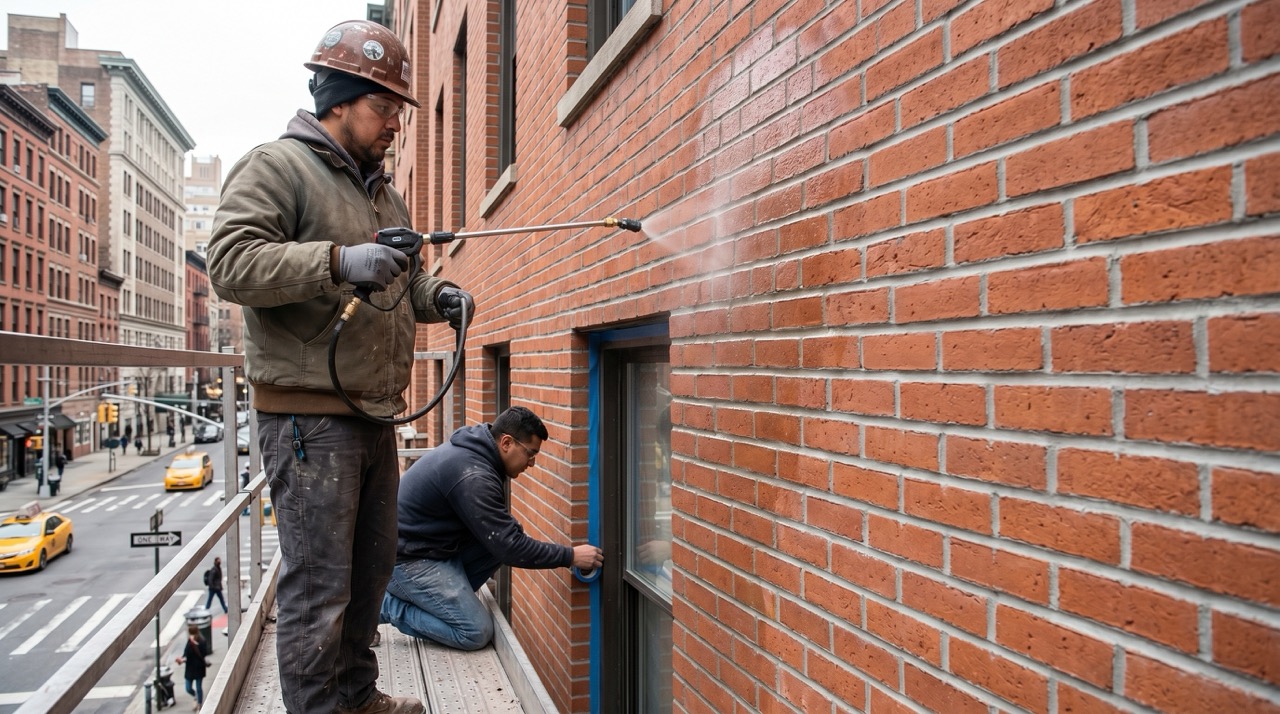
Facade Waterproofing
Water is the primary driver of facade deterioration in New York City. Even a well-maintained brick building with sound mortar joints allows some water to penetrate during wind-driven rain events. When joints fail, when caulk around windows deteriorates, when flashing fails at horizontal surfaces, the water intrusion accelerates every other form of facade damage: freeze-thaw spalling, lintel corrosion, interior mold and staining. Facade waterproofing — done correctly — is the most effective long-term investment in a building’s exterior. LL11 Facade Repairs Contractor NYC provides facade waterproofing services for NYC buildings with a system approach: we address the sources, not just the symptoms.
What Facade Waterproofing Means for NYC Buildings
Waterproofing a building facade is not simply spraying a coating on the outside. Effective waterproofing requires:
- Air and water barrier continuity — Flashing, caulk joints, and penetrating treatments must work together as a continuous system. One failure point defeats the whole system.
- Vapor management — Treatments must not trap moisture inside the wall assembly. Historic masonry walls are designed to breathe; non-breathable coatings on historic brick cause accelerated spalling.
- Surface preparation first — Repointing, crack repair, and lintel work must be completed before waterproofing treatment. Sealing over deficiencies traps moisture and accelerates deterioration.
Facade Waterproofing Services
Penetrating Silane and Siloxane Water Repellents
The standard treatment for brick and concrete facades is a penetrating silane or siloxane product that impregnates the surface pores without forming a surface film. These products reduce water absorption by 80-95% while maintaining vapor permeability — the wall continues to breathe, but water from outside cannot enter.
We select the product formulation (silane, siloxane, or siliconate) based on the substrate type, the pore structure, and the severity of the moisture exposure. Application rates and methods matter: inadequate coverage leaves gaps in the treatment.
Penetrating water repellents are appropriate for most brick, concrete, and stone surfaces. They are not a film-forming coating and will not change the appearance of the facade.
Sealant and Caulk Systems
Perimeter caulk around windows is typically the first waterproofing component to fail on NYC buildings — exposed to ultraviolet light, temperature cycling, and building movement, most sealants have a service life of 10-15 years before they crack, debond, or become excessively hard.
We remove failed sealant, prepare joint faces, install appropriately sized closed-cell backer rod, and apply a polyurethane or silicone sealant formulated for the specific exposure. Joint size and movement range determine the appropriate sealant type — there is no single product appropriate for all joints.
Control joints in concrete facades, expansion joints in large masonry walls, and building-structure-to-facade connections all require sealant maintenance on a regular schedule.
Through-Wall and Cap Flashing Systems
Horizontal surfaces — parapets, window heads, sill ledges, balcony edges, cornices — are where water enters building walls. Flashing that spans from the exterior to the interior of the wall at these locations must be continuous, properly lapped, and terminated to prevent water from tracking back into the wall.
We install new through-wall flashing using aluminum, copper, or elastomeric sheet materials appropriate to the specific condition. Parapet cap flashing at the top of exterior walls — particularly critical on pre-war NYC buildings with open-jointed coping stones — is inspected and replaced where failed.
Roof-to-Wall Transition Waterproofing
The joint between the roof membrane and the exterior wall is a major water entry point. We coordinate roof-to-wall waterproofing repairs in conjunction with facade work, ensuring the transition is continuous and properly flashed rather than relying on caulk alone at this high-movement joint.
Waterproofing Coatings (Commercial and Non-Historic Buildings)
For commercial buildings and post-war buildings without historic masonry concerns, we apply elastomeric waterproofing coatings over properly prepared and repaired surfaces. These coatings bridge hairline cracks and provide durable waterproofing for facades in good structural condition. We do not apply these products to pre-war brick buildings or LPC-designated facades.
NYC Facade Waterproofing Company: Sequencing Matters
The most common waterproofing mistake is treating the surface before repairing the deficiencies beneath it. We always sequence work correctly:
- Structural repairs and repointing first
- Joint sealant work second
- Penetrating treatment or coating last
Applying waterproofing over failed mortar joints or unsealed cracks simply seals water inside the wall rather than keeping it out.
Service Areas for Facade Waterproofing
We provide facade waterproofing services throughout New York City: all Manhattan neighborhoods, Brooklyn (including the dense pre-war stock of Park Slope, Crown Heights, Williamsburg, and Flatbush), Queens, the Bronx, and Staten Island.
Request a Free Quote
Waterproofing scope and appropriate treatment type depend on the building’s material, existing condition, moisture history, and waterproofing objectives. Contact LL11 Facade Repairs Contractor NYC for a site assessment.
Call (917) 540-6852 or use the contact form below.
Frequently Asked Questions — Facade Waterproofing NYC
Can I just spray a waterproof coating on my brick building? Surface-bonded waterproofing coatings should not be applied to historic brick buildings. These products trap moisture inside the wall, accelerating freeze-thaw spalling. The appropriate treatment for historic masonry is a penetrating silane or siloxane water repellent that reduces surface absorption while maintaining vapor permeability. All repointing and joint repairs must be completed before any treatment is applied.
How often does perimeter window caulk need to be replaced? In NYC’s climate, most polyurethane window perimeter sealants have a service life of 10-15 years before they require replacement. Signs of failure include: cracking, hardening, pulling away from the substrate on one or both sides, and visible gaps. Failed sealant should be replaced promptly — it’s relatively inexpensive compared to the interior damage that results from years of water infiltration.
What is the most important waterproofing work for a pre-war NYC building? Mortar joint repointing is the single most effective waterproofing intervention for pre-war brick buildings — it addresses the most common water entry path. After repointing, perimeter window sealant replacement and parapet flashing repair typically provide the highest return on waterproofing investment.
How long does facade waterproofing treatment last? Penetrating silane and siloxane water repellents typically provide effective protection for 8-15 years, depending on the specific product, surface porosity, and UV exposure. Sealant systems should be inspected every 5-7 years and reapplied as needed. Flashing systems, when properly installed, should provide 20+ years of service.
Does facade waterproofing work need to be done in specific weather conditions? Yes. Most sealant applications and penetrating treatments require ambient temperatures above 40°F and dry substrate conditions. Some products have wider application windows with appropriate surface preparation. We schedule waterproofing work to align with appropriate seasonal conditions.