Concrete Facade Repair
Concrete facade failures in New York City are a distinct problem from brick masonry deterioration — different materials, different failure modes, different repair requirements. The city’s mid-century residential and commercial buildings (roughly 1950s through 1980s) use concrete extensively: poured-in-place structural frames, precast concrete panels, cast stone ornament, and exposed aggregate cladding. When these concrete surfaces delaminate, crack, or spall, the falling hazard is immediate and the FISP consequences are serious. LL11 Facade Repairs Contractor NYC specializes in concrete facade repair for NYC buildings, with FISP-compliant documentation and DOB clearance filing.
Concrete Facade Failures: What Causes Them in NYC
Understanding why concrete fails is essential to repairing it correctly. The primary failure mechanisms in New York City’s climate are:
Corrosion of embedded reinforcing steel — When chloride ions from road salt, seawater, or airborne pollution penetrate concrete and reach the steel reinforcement, the steel corrodes. Corrosion products expand, cracking the concrete cover from within. This produces the characteristic rust staining and delamination seen on post-war concrete buildings throughout the outer boroughs.
Freeze-thaw cycles — Water that penetrates concrete through cracks or porous surfaces expands when it freezes, degrading the paste structure and aggregate bond. NYC averages 80+ freeze-thaw cycles per year — enough to degrade concrete surfaces progressively over decades.
Carbonation — CO2 from urban air reacts with concrete’s alkaline cement paste, reducing the pH around reinforcing steel and allowing corrosion to initiate even without chloride presence. Older concrete buildings in dense urban environments are particularly susceptible.
Alkali-silica reaction (ASR) — A chemical reaction between certain aggregate types and the cement alkalis that produces an expansive gel. Less common in NYC than chloride-induced corrosion, but present in some building stocks.
Original design and construction deficiencies — Many NYC concrete buildings from the 1960s-70s were constructed with inadequate concrete cover over reinforcing steel. When this thin cover carbonates or chlorides penetrate, corrosion initiates quickly.
Concrete Facade Repair Services
Delamination Removal and Surface Repair
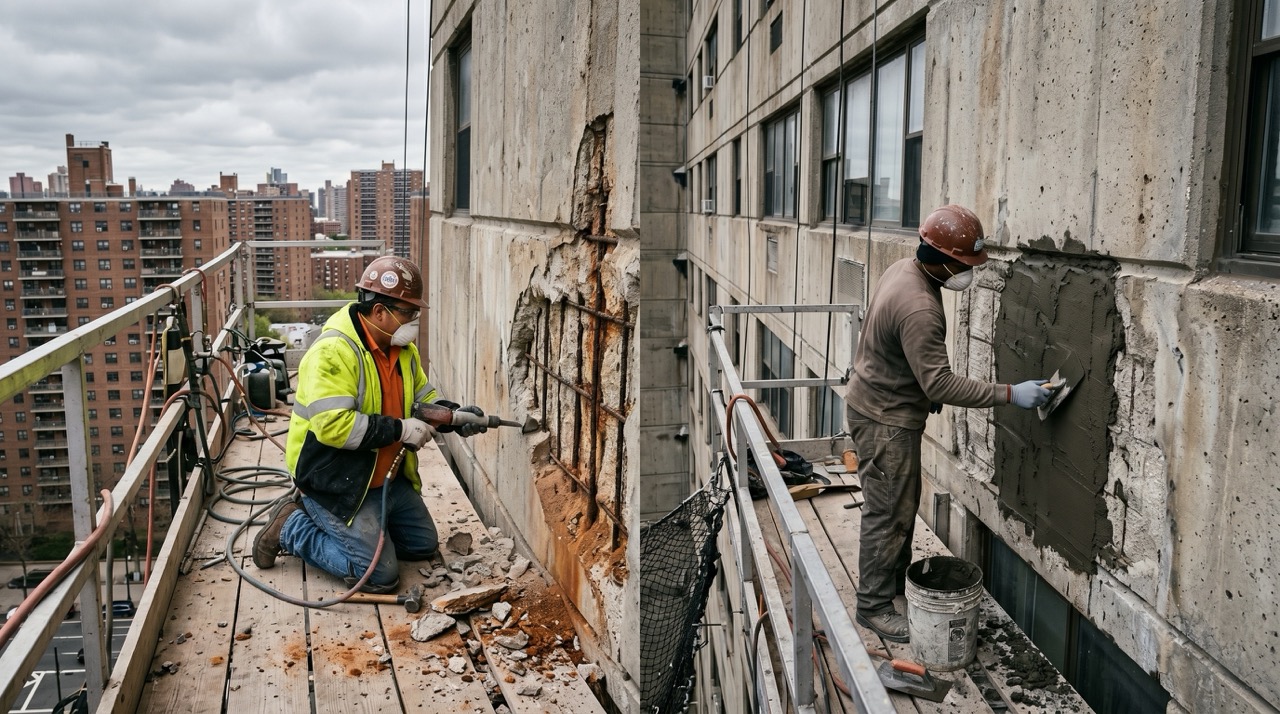
Delaminated concrete is a FISP Unsafe trigger. We remove all delaminated material by sounding, saw cutting to sound concrete, and chipping using methods that don’t damage sound surrounding concrete. The exposed reinforcing steel is evaluated — active corrosion is treated with zinc anodes or migrating corrosion inhibitor systems before repair mortar is applied.
We restore concrete surfaces using polymer-modified repair mortars designed to bond to existing concrete and match the profile, texture, and color of the surrounding material. For exposed surfaces, we apply penetrating anti-carbonation coatings or silane sealers to slow re-deterioration.
Structural Concrete Crack Repair
Structural cracks — those indicating movement, load transfer issues, or inadequate reinforcing — require engineering review before repair. We coordinate with structural engineers where the crack pattern suggests structural causes rather than surface deterioration.
Non-structural cracks are routed and sealed with flexible polyurethane or epoxy sealants, or bridged with polymer-modified mortar depending on crack width and the expected movement.
Precast Concrete Panel Repair and Sealing
Precast concrete panels from the 1960s and 1970s — common on NYC public housing and commercial buildings — develop both surface deterioration and joint seal failures. We repair panel surfaces and replace deteriorated joint sealants with polyurethane materials formulated for high movement and weather exposure.
Panel connections are inspected where access allows. Corroded connection hardware identified by the QEWI is documented for structural engineering review and repair.
Cast Stone and Architectural Concrete Repair
Pre-war and early mid-century buildings often used cast stone — a high-quality concrete product cast to resemble natural stone for cornices, window surrounds, and ornamental elements. Cast stone deteriorates differently from structural concrete, and repair requires color-matched patching mortars and careful attention to ornamental profiles.
Parapet and Balcony Concrete Repair
Concrete parapets and balconies take the hardest environmental punishment. Balcony slab edges and soffits are particularly vulnerable to chloride infiltration and rebar corrosion. We repair concrete balcony edges, address drainage conditions that accelerate deterioration, and install sacrificial zinc anodes where appropriate to slow future corrosion.
NYC Concrete Facade Repair Contractors: Our Approach
Concrete repair is not patch-and-go work. We follow established repair material and method standards (ACI 546, ICRI guidelines) and select repair products based on the specific failure mechanism, substrate condition, and exposure environment. Using the wrong repair mortar — particularly one that’s too rigid or too porous — can accelerate deterioration of the surrounding concrete rather than arresting it.
Color matching matters. The visual difference between a patch and the surrounding concrete is a permanent record of repairs done poorly. We invest time in mix design and mock-ups to achieve acceptable color and texture match for visible surfaces.
FISP documentation. All concrete repairs are documented with before/after photographs, material specifications, and repair extents mapped on elevation drawings — the documentation package needed for QEWI re-inspection and DOB amended filing.
Service Areas for Concrete Facade Repair
We serve buildings throughout all five boroughs with heavy concrete repair capability: Manhattan, Brooklyn, Queens, the Bronx (particularly the 1960s-70s residential stock throughout the Bronx), and Staten Island.
Request a Free Quote
Concrete facade repair scope depends on the extent of delamination, the reinforcing steel condition, and the building’s height and access configuration. Contact LL11 Facade Repairs Contractor NYC for a site assessment.
Call (917) 540-6852 or use the contact form below.
Frequently Asked Questions — Concrete Facade Repair NYC
What causes concrete to spall and delaminate on NYC buildings? The primary cause is corrosion of embedded reinforcing steel, driven by chloride infiltration (from road salt and urban pollution) or concrete carbonation reducing the pH at the steel. Corroding steel expands and cracks the concrete cover, leading to delamination. Freeze-thaw cycling accelerates the process by enlarging existing cracks each winter.
Is delaminated concrete dangerous? Yes. Delaminated concrete that separates from the facade at any height is a serious falling hazard and typically triggers an UNSAFE designation under FISP. It requires immediate attention, including protective measures for pedestrians below while repairs are planned.
How are concrete repairs matched to the existing color? Color matching in concrete repair is challenging because concrete changes color over time due to weathering, dirt accumulation, and carbonation. We prepare repair mortar trial mixes in the field, apply small test patches in inconspicuous locations, and allow them to cure before comparing to the existing surface. Perfect matching is rarely achievable, but acceptable visual integration is the goal.
How long do concrete facade repairs last? With proper repair materials, surface preparation, and substrate treatment, concrete repairs in appropriate exposure conditions should provide 15–20+ years of service. The durability depends heavily on whether the root cause (typically reinforcing corrosion) is addressed in addition to surface patching.
Do you work on NYC Housing Authority (NYCHA) buildings? We work on a range of concrete building types throughout the outer boroughs. For large institutional and public housing projects, please contact us to discuss your specific project scope and procurement requirements.