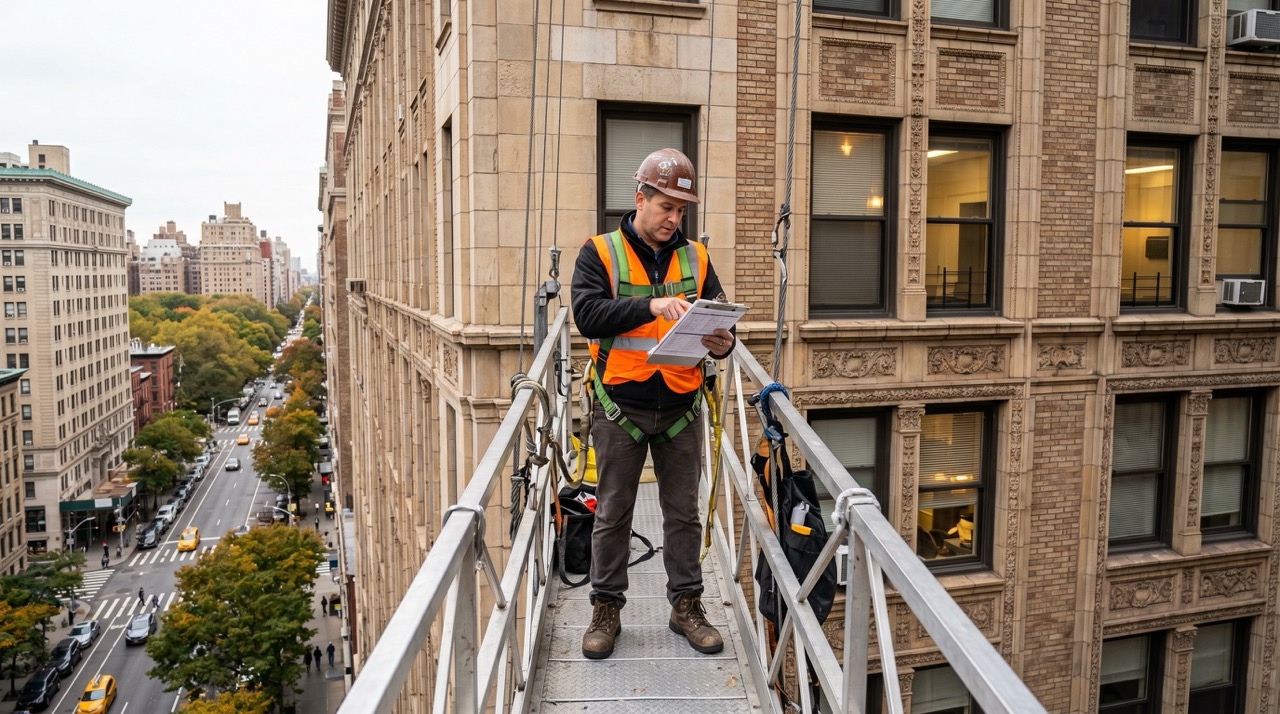
LL11 Facade Inspections
Local Law 11 facade inspections are not optional, and they’re not a formality. For any NYC building six stories or taller, FISP compliance is a legal requirement — and the QEWI report you file determines your building’s status, your civil penalty exposure, and the timeline for any required repairs. LL11 Facade Repairs Contractor NYC conducts LL11 facade inspections with licensed QEWIs and provides the full repair-and-refile service when deficiencies are found.
What Is a Local Law 11 Facade Inspection?
Local Law 11, formally administered as the Facade Inspection Safety Program (FISP) by the NYC Department of Buildings, requires that buildings with more than six stories have their exterior walls and appurtenances inspected by a Qualified Exterior Wall Inspector (QEWI) on a five-year cycle.
The QEWI examines all elevations of the building — primary street-facing facades, side and rear walls, parapets, copings, cornices, window sills, lintels, balconies, and fire escapes. The inspection includes close-up physical access for every facade surface, not just visual review from the street.
After inspection, the QEWI files a technical report with the DOB classifying each elevation:
- Safe — No deficiencies noted; no repairs required for this cycle
- SWARMP (Safe With a Repair and Monitoring Program) — Deficiencies present but not immediately hazardous; building must complete repairs and file an amended report within the cycle window
- Unsafe — Immediate hazard to public safety; sidewalk protection required within 24 hours, repairs required within DOB-mandated timeline
LL11 Inspection Cycle Schedule: Where NYC Buildings Stand in 2025-2026
FISP inspections are staggered across sub-cycles by block number. Cycle 9 sub-cycle deadlines run through 2024. Cycle 10 is now opening, with sub-cycle filings beginning in 2025.
If your building missed a Cycle 9 deadline, you are already accruing civil penalties and must file immediately. Late filings carry additional fees beyond the base violation penalties.
If you are preparing for Cycle 10, now is the time to schedule your QEWI inspection. Sub-cycle windows open based on your block number — do not wait until the filing deadline approaches, as licensed QEWIs have limited capacity during peak periods.
Our LL11 Facade Inspection Services
QEWI Inspection Coordination
We work with licensed QEWIs to schedule and conduct inspections that meet all DOB requirements. The inspection includes full close-up access to all elevations, with scaffolding, rope access, or aerial lift as required by the building’s configuration.
Comprehensive Technical Reporting
Our inspection reports document every deficiency with photographs, location references (elevation, floor level, bay), defect type, and severity classification. This documentation supports accurate FISP filing and, if repairs are required, provides the scope basis for contractor pricing.
SWARMP and Unsafe Repair Services
When the inspection identifies conditions requiring repair, we can proceed directly to remediation as the same company. There’s no coordination gap between the inspector’s findings and the repair contractor’s scope — we use the same documentation to plan and execute repairs.
Amended FISP Filing
After repairs are complete, we coordinate the QEWI re-inspection and file the amended report with DOB NOW: Safety to update the building’s classification from SWARMP or Unsafe to Safe.
What LL11 Inspections Actually Look For
A thorough QEWI inspection examines far more than visible cracks. The physical conditions most commonly found on NYC facades include:
Mortar joint deterioration — The most common deficiency, particularly on pre-war brick buildings. Failed mortar allows water to penetrate behind the facade, accelerating freeze-thaw damage and eventual spalling.
Spalling and delaminating brick or concrete — Loose material at any height is an Unsafe condition. FISP inspectors test brick and concrete surfaces for hollow areas that indicate delamination.
Terra cotta failures — Hollow or cracked terra cotta units on ornamental pre-war facades represent a serious falling hazard. Close-up inspection is required to identify hollow units that appear sound from the street.
Lintel and shelf angle corrosion — Steel lintels and shelf angles embedded in masonry corrode over time, expanding and cracking the surrounding brick. Visible rust staining and cracking above window openings are FISP flags.
Parapet instability — Parapets that have moved, tilted, or show significant cracking are a major Unsafe trigger, given the catastrophic hazard of a parapet collapse.
Window and caulk joint failures — Deteriorated perimeter caulk around windows and failing sill conditions allow water to enter the wall assembly, creating long-term deterioration risks.
Balcony and fire escape conditions — Structural steel balconies and fire escapes are included in FISP scope and inspected for corrosion, connection integrity, and drainage function.
FISP Cycle 10: What’s Changing
The DOB has been updating FISP requirements over successive cycles. Cycle 10 introduces enhanced close-up access requirements — specifically, all exterior surfaces must receive close-up inspection using scaffolding, suspended scaffold, aerial lift, or rope access. Previous cycles allowed some visual inspection from the ground for certain conditions.
This means inspection costs and timelines for Cycle 10 will reflect more comprehensive access than some building owners may have experienced in prior cycles. Plan for scaffold or access equipment costs as part of your FISP compliance budget.
Why Building Owners Choose LL11 Facade Repairs Contractor NYC for FISP Inspections
We operate exclusively in New York City and work solely on building envelopes. Our team knows the pre-war building stock of Manhattan, Brooklyn, and the Bronx — limestone facades, terra cotta ornament, brick bearing-wall construction, early concrete — and the specific failure patterns common to each era and material type.
We produce inspection reports that are complete, accurate, and filed correctly on first submission. A poorly documented FISP report can generate DOB objections that delay clearance and create additional expense. Our reporting is built around what the DOB actually requires, not a generic template.
Call (917) 540-6852 to schedule your LL11 facade inspection. We serve all five boroughs.
Areas Served for LL11 Facade Inspections
We provide FISP inspection services throughout New York City: Manhattan (Midtown, Upper West Side, Upper East Side, Harlem, Washington Heights), Brooklyn (Park Slope, Williamsburg, Crown Heights, Flatbush, Bay Ridge), Queens (Long Island City, Astoria, Jackson Heights, Flushing), the Bronx (Riverdale, Fordham, Concourse), and Staten Island.
Request a Free Quote
FISP inspection costs depend on building height, number of elevations, access configuration, and the scope of close-up access required. Contact LL11 Facade Repairs Contractor NYC for a quote based on your specific building.
Call (917) 540-6852 or use the contact form below.
Frequently Asked Questions — LL11 Facade Inspections NYC
How often is a Local Law 11 inspection required in NYC? Local Law 11 (FISP) requires facade inspections every five years. The city staggers inspection deadlines across sub-cycles by block number to distribute the workload. Your building’s specific sub-cycle deadline determines when you must file.
What happens if a building fails a Local Law 11 inspection? There is no “pass/fail” — instead, the inspection results in a classification: Safe, SWARMP, or Unsafe. SWARMP requires a repair-and-monitoring plan and amended filing within the cycle. Unsafe requires immediate protective measures and repairs within a DOB-mandated timeline. Failure to address the classification results in civil penalties and potential escalation.
What does a QEWI need to inspect under FISP? A Qualified Exterior Wall Inspector must conduct close-up inspection of all exterior walls and appurtenances of the building: all facade elevations, parapets, cornices, window sills, lintels, balconies, fire escapes, and any projecting elements. Under Cycle 10, all surfaces require close-up physical access — ground-level visual inspection is not sufficient for any portion of the facade.
Can the same company do the inspection and the repair? Yes. Many building owners prefer to use an integrated contractor that conducts the inspection and performs the repair, because it eliminates coordination gaps and ensures repair scope is based on the actual FISP findings. LL11 Facade Repairs Contractor NYC provides both services.
What is the difference between Local Law 11 and FISP? They refer to the same program. “Local Law 11” is the original New York City law (passed in 1998) that created mandatory facade inspection requirements. The NYC DOB administers the program under the name FISP — Facade Inspection Safety Program. The two terms are used interchangeably.