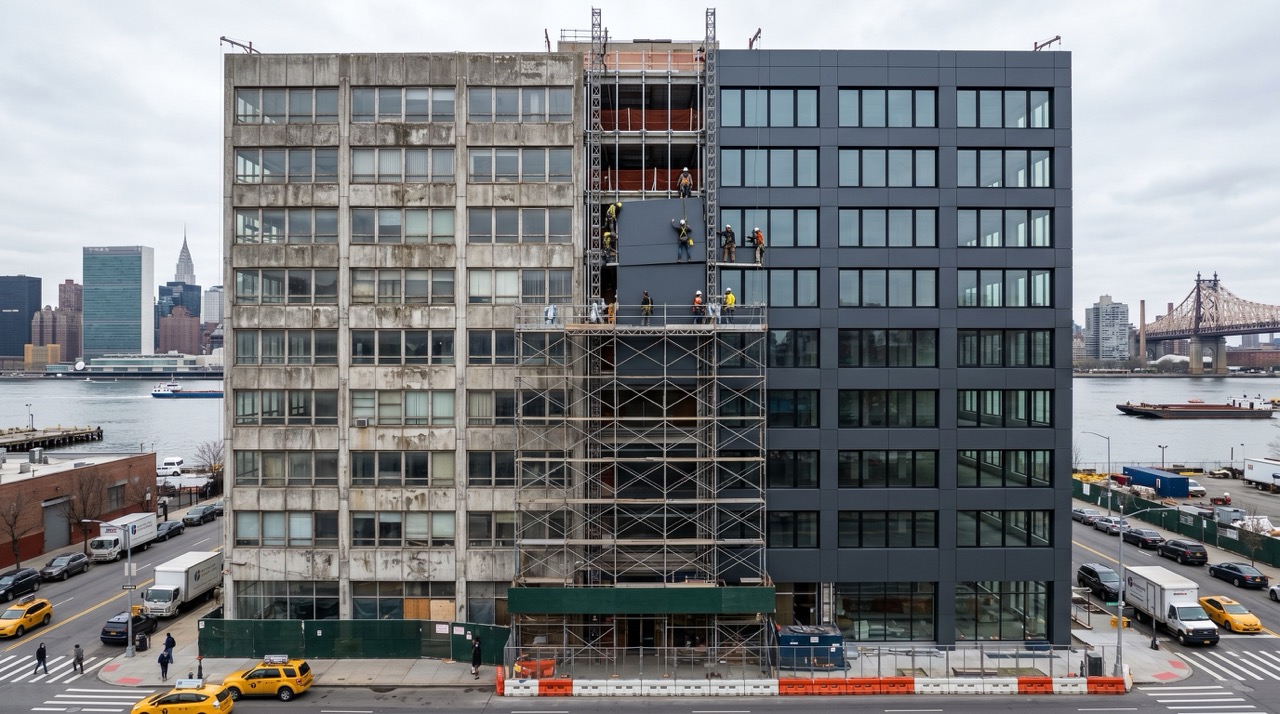
Facade Re-Cladding
Some buildings have facades that are beyond economical repair — where the existing cladding has deteriorated past the point where maintenance and repair are cost-effective, or where the building owner needs to modernize the exterior for functional, aesthetic, or energy performance reasons. Facade re-cladding replaces the existing exterior cladding system with a new one, typically while retaining the structural backup wall. LL11 Facade Repairs Contractor NYC provides facade re-cladding services for commercial and multi-family buildings throughout New York City.
What Is Facade Re-Cladding?
Re-cladding is the process of installing a new exterior cladding system over or in replacement of the existing facade. Unlike repair, which extends the life of the existing material, re-cladding provides a completely new weather barrier and exterior finish.
Common re-cladding scenarios include:
- Post-war concrete panel buildings where the existing panels are extensively deteriorated and individual repair is no longer economical
- Commercial buildings with failing curtain wall or window wall systems
- Multi-family buildings where the owner wants to improve thermal performance and reduce long-term maintenance costs
- Buildings where the existing facade material is inappropriate (e.g., exterior EIFS over a substrate that’s failing) and a replacement system is needed
Re-cladding is not appropriate for most historic pre-war buildings, where the original masonry is both structurally integral and architecturally significant.
Re-Cladding Systems We Install
Metal Panel Systems
Aluminum composite panel (ACP) and single-skin aluminum panel systems provide durable, low-maintenance cladding for commercial and multi-family applications. Installed over a continuous air and water barrier and thermally broken subframing, they significantly improve the building’s thermal performance over original concrete or masonry construction.
Metal panel re-cladding is common on 1960s and 1970s office and residential buildings in Midtown and the outer boroughs where the original precast concrete or brick-and-block construction has deteriorating thermal and moisture performance.
Fiber Cement Cladding
Fiber cement panel systems offer a more architectural appearance than metal panel at lower cost, with good durability and fire resistance. They’re commonly used on residential re-cladding projects where the building owner wants an updated look without the premium of aluminum.
Brick Veneer Re-Cladding
Thin brick veneer or full-brick masonry veneer on a new backup system can replace deteriorated masonry facades while maintaining a traditional brick appearance. This approach is common on mid-century buildings where the original masonry backup is sound but the face brick is extensively deteriorated.
Window Wall and Curtain Wall Replacement
Failing window wall or curtain wall systems on commercial and institutional buildings require replacement rather than repair when the system has deteriorated to the point where individual unit repairs are no longer effective. We manage window wall replacement projects as part of comprehensive facade re-cladding scope.
Facade Re-Cladding Process
Condition Assessment and Engineering — Re-cladding requires structural engineering input to ensure the existing backup structure can support the new system, and to design the attachment details. We coordinate engineering as part of the project.
System Selection and Design — We work with building owners and architects to select the re-cladding system that meets the aesthetic, functional, and budget requirements for the project.
DOB Permit Filing — Facade re-cladding is a permitted scope of work in New York City. We manage permit filing and DOB coordination, including structural engineer sign-off on the connection details.
Installation — Re-cladding requires scaffold access for the full height of the building. We manage scaffold installation and removal as part of the project.
Window and Opening Integration — New windows or replacement of existing windows is typically part of a re-cladding project. We coordinate window and opening treatment as part of the full envelope scope.
Facade Re-Cladding Contractors NYC: Project Considerations
Access and logistics — A full building re-cladding in Manhattan or a dense outer-borough neighborhood requires careful logistics planning: scaffold permit coordination with DOT, material staging on limited sidewalk space, and construction sequencing to minimize building occupant disruption.
FISP during construction — If your building is in a FISP cycle during a re-cladding project, the DOB filing obligations continue. We coordinate FISP compliance with re-cladding construction scheduling.
Energy code compliance — New facade systems must meet the NYC Energy Conservation Code requirements for continuous insulation and thermal bridging. We design re-cladding systems to meet current energy code as part of the project.
Service Areas for Facade Re-Cladding
We provide facade re-cladding services throughout New York City, with particular experience in commercial corridors and residential districts with concentrations of 1960s-1980s buildings: Midtown Manhattan, Long Island City (Queens), Downtown Brooklyn, and residential neighborhoods in the Bronx and Staten Island.
Request a Free Quote
Re-cladding scope and system selection significantly affect project cost. Contact LL11 Facade Repairs Contractor NYC for a site assessment and consultation.
Call (917) 540-6852 or use the contact form below.
Frequently Asked Questions — Facade Re-Cladding NYC
When does facade re-cladding make more sense than repair? Re-cladding generally makes more sense when: the existing cladding is so extensively deteriorated that repair costs approach replacement costs; the existing system has fundamental performance deficiencies (inadequate insulation, poor moisture management) that cannot be economically corrected by repair; or the building owner has aesthetic or functional goals that require a new exterior system.
Does facade re-cladding require a DOB permit in NYC? Yes. Facade re-cladding is a significant alteration that requires a DOB building permit, structural engineering sign-off, and in some cases, special inspection. We manage the full permit and DOB coordination process.
How does re-cladding affect building occupants? External facade re-cladding work generates noise and scaffold access but does not typically require occupants to vacate. Windows must be temporarily sealed during window replacement work, but building access and habitability are maintained throughout construction in virtually all cases.
Can re-cladding improve the building’s energy performance? Yes, significantly. Modern re-cladding systems with continuous insulation, thermally broken framing, and high-performance window units dramatically reduce heat loss compared to original 1960s-70s construction, which typically had minimal or no insulation. Improved energy performance reduces operating costs and may qualify for utility incentives.
How long does a facade re-cladding project take? A full building re-cladding depends heavily on building size. A 10-story residential building might take 4-8 months from mobilization to scaffold removal. Larger commercial or mixed-use buildings take longer. Pre-project activities (engineering, permitting, material procurement) add several months to the overall timeline.