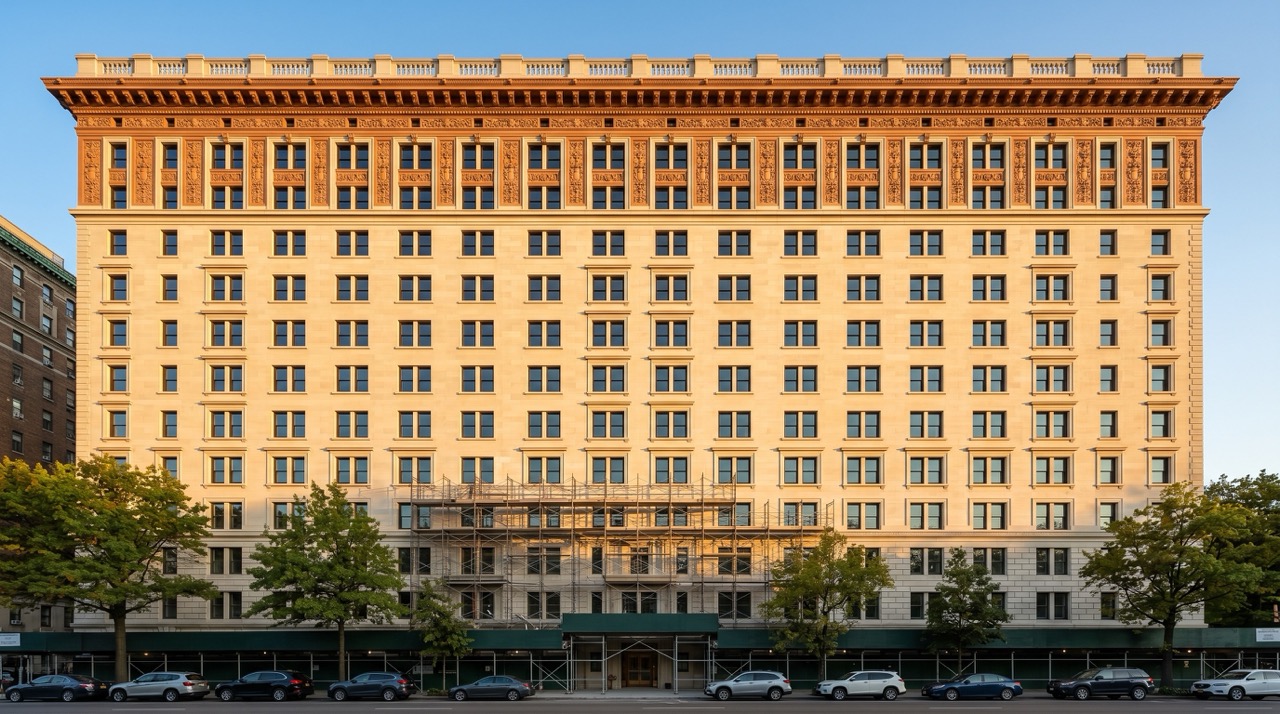
Historic Building Restoration
New York City’s pre-war buildings are not just aging infrastructure — they’re architectural heritage. The limestone-clad co-op towers on Central Park West, the ornate brick and terra cotta tenements in Harlem and Washington Heights, the Beaux-Arts commercial buildings along lower Broadway, the Grand Concourse’s Art Deco apartment houses — these buildings represent a density of historic architecture matched by very few cities in the world. Preserving and restoring them requires genuine expertise in historic materials, techniques, and the regulatory processes that govern work on designated buildings. LL11 Facade Repairs Contractor NYC provides historic building restoration services for NYC’s pre-war building stock.
Historic Facade Restoration: What It Actually Involves
Restoration of a historic building facade is fundamentally different from general construction. The goal is to return the facade to a stable, sound condition using materials and methods compatible with the original construction — not to renovate or update it.
The Secretary of the Interior’s Standards for Rehabilitation (adopted by NYC’s Landmarks Preservation Commission as the basis for evaluating proposed work) establish the framework: retain and repair original materials where possible; replace only what is beyond repair; replacement materials must match the original in form, design, and texture; do not introduce changes that diminish the historic character.
These aren’t abstract principles — they translate directly into technical requirements that affect how we assess conditions, select repair materials, and document our work.
Services We Provide for Historic Building Restoration
Historic Masonry Assessment and Condition Survey
A thorough condition survey is the foundation of any historic restoration project. We document every facade elevation with close-up photographic coverage, map deficiency types and locations, sample mortar from multiple locations for mortar analysis, and review available historical documentation (original drawings, prior inspection reports) to understand the original construction.
Mortar analysis is particularly important on historic buildings — we need to know the original binder composition and aggregate characteristics to formulate a compatible repair mortar. A mortar that’s too hard damages original brick; a mortar that’s too soft won’t hold.
Lime-Based Mortar Repointing
Historic masonry in New York City — buildings from roughly 1850 through the 1930s — was originally built with natural hydraulic lime or early Portland cement mortars that are softer than modern Portland-heavy mortars. Repointing these buildings requires mortar compatible with the original: lime-rich, with appropriate aggregate gradation and color.
We perform mortar analysis, formulate compatible repair mortars, and execute repointing work that matches the original joint width, profile, and color. This is foundational preservation work — done correctly, it protects the building for decades; done incorrectly (with too-hard mortar), it accelerates brick deterioration.
Stone Consolidation and Repair
Brownstone, limestone, bluestone, and sandstone deteriorate differently than brick — through sugaring (binder loss), scaling (surface layer separation), and joint deterioration. We use mineral consolidants appropriate to the specific stone type to stabilize friable surfaces, compatible repair mortars for missing material, and, where necessary, replacement stone sourced from matching quarries or salvage.
LPC Review Coordination and Specification Preparation
Work on landmarked buildings or buildings in historic districts in New York City requires review and approval by the Landmarks Preservation Commission before work begins. We prepare the technical specifications and documentation required for LPC Certificate of Appropriateness (C of A) applications, coordinate with LPC staff during the review process, and implement approved work in compliance with the C of A.
This coordination is not optional. Unauthorized work on a landmarked building carries significant penalties and can require removal of non-approved work at the owner’s expense.
Historic Window Surround and Ornamental Detail Repair
Pre-war facades are rich in carved and cast detail — limestone window surrounds, terra cotta ornamental band courses, carved brownstone stoops, cast iron decorative elements. When these elements deteriorate, replacement or repair requires sourcing appropriate materials and skilled craft labor.
We repair historic window surrounds, cornices, belt course elements, and other ornamental details using material-appropriate methods: stone consolidants and compatible mortar for limestone and brownstone, custom-fabricated terra cotta or GFRC substitutes for failed ceramic ornament, and cast iron repairs where feasible.
FISP Integration for Historic Buildings
Historic buildings are still subject to Local Law 11 FISP requirements. We integrate restoration work with FISP compliance, sequencing repairs to address FISP-cited UNSAFE conditions first while planning comprehensive restoration work for the subsequent phases. Our FISP documentation for historic buildings includes the additional material and method information required to demonstrate compliance without use of inappropriate modern materials.
Pre-War Building Types We Specialize In
Limestone and brick pre-war apartment towers — The 1920s and 1930s co-op and rental buildings along Fifth Avenue, Central Park West, Riverside Drive, and similar Manhattan corridors. Typically feature brick construction with limestone veneer, elaborate classical ornament, and original steel windows.
Brick tenement buildings — The late 19th and early 20th century residential buildings that define neighborhoods like Harlem, Washington Heights, the Lower East Side, and much of Brooklyn and the Bronx. Primarily brick with corbeled brick ornament and minimal stone or terra cotta.
Terra cotta-clad commercial and residential buildings — Particularly common in Midtown, Downtown Brooklyn, and along the Grand Concourse in the Bronx. Elaborate glazed and unglazed terra cotta cladding requiring specialist assessment and repair.
Beaux-Arts and neoclassical buildings — Dense ornamental detail in limestone and terra cotta. Requires careful material matching and craft-level restoration work.
Art Deco apartment buildings — Common on the Grand Concourse in the Bronx, in Midtown, and in neighborhoods like Jackson Heights in Queens. Feature geometric terra cotta ornament, metal spandrel panels, and decorative brick patterns.
Service Areas for Historic Building Restoration
We work on historic buildings throughout New York City, with particular depth of experience in neighborhoods with high concentrations of pre-war buildings: the Upper West Side, Upper East Side, Harlem, Washington Heights, and Midtown in Manhattan; Park Slope, Prospect Heights, Crown Heights, Williamsburg, and Brooklyn Heights in Brooklyn; the Grand Concourse corridor in the Bronx.
Request a Free Quote
Historic restoration projects require thorough assessment before a meaningful scope and price can be developed. Contact LL11 Facade Repairs Contractor NYC for a site assessment.
Call (917) 540-6852 or use the contact form below.
NYC Historic Building Restoration Contractors
Not every facade contractor has experience working within the LPC’s regulatory framework or with historic materials. When selecting a contractor for a pre-war or landmarked building, verify that they have direct experience with LPC Certificate of Appropriateness applications, mortar analysis and compatible mortar formulation, and sourcing of period-appropriate replacement materials.
LL11 Facade Repairs Contractor NYC has completed historic restoration projects across Manhattan, Brooklyn, and the Bronx — in designated historic districts and on individually landmarked buildings. We prepare LPC applications directly, manage the review process, and execute approved work with crews experienced in lime-based masonry and historic material handling.
Historic Facade Repair and Restoration Methods
The distinction between repair and replacement matters significantly in historic preservation. The Secretary of the Interior’s Standards and LPC guidelines both establish a hierarchy: preserve what exists, stabilize what is deteriorating, repair with compatible materials, and replace only what is beyond repair.
In practice, this means:
- Repointing takes precedence over mortar removal and rebuild
- Consolidation of deteriorating stone takes precedence over patching
- Selective unit replacement using salvaged or matched materials takes precedence over panel replacement
- Minimal intervention is the standard — do what is necessary to achieve stability, not what would achieve a new-looking result
This approach protects the building’s historic character and its LPC approvals, and it typically produces longer-lasting results than aggressive intervention.
How Long Does Historic Facade Restoration Take?
Timeline depends primarily on project scope, LPC review schedule, and access logistics. A repointing project on a mid-size landmarked building typically runs 8-16 weeks from inspection through completion (including LPC review). Projects requiring custom-fabricated terra cotta replacement units add lead time for fabrication — typically 12-20 weeks for custom units.
For projects with FISP UNSAFE citations, the initial protective measures (sidewalk bridge, netting) can be installed within days of engagement, providing DOB compliance while the repair scope and LPC approval are being processed.
Frequently Asked Questions — Historic Building Restoration NYC
What is the Landmarks Preservation Commission and when does it apply? The NYC Landmarks Preservation Commission (LPC) regulates exterior changes to individually landmarked buildings and buildings in designated historic districts. If your building has a Landmark status indicator in the DOB record, or is located in a historic district (common in neighborhoods like the Upper West Side, Park Slope, and Brooklyn Heights), LPC review is required for any facade work beyond ordinary maintenance.
Can I use modern materials to repair a historic building? The LPC evaluates each case, but the general standard is that repair materials must match the historic materials in composition, form, and appearance as closely as possible. Modern Portland cement mortars are generally not approved for repointing historic brick; modern replacement stone must match the original in color and texture. We work within LPC standards and prepare specifications that will receive approval.
How long does LPC review take for facade work? Standard review (for work on individually landmarked buildings or in historic districts) typically takes 4-8 weeks from submission to determination, assuming a complete application. Complex work or applications that require a full public hearing take longer. For emergency UNSAFE conditions, expedited LPC review is available, though it still requires an application.
Is historic restoration more expensive than standard facade repair? Yes, generally. Material matching requirements, mortar analysis, LPC coordination, and the craft-level precision required for historic work add cost compared to standard repair. However, preservation work done correctly extends the life of the building and protects its value — incompatible repairs done cheaply often require expensive remediation within years.
Do FISP requirements still apply to landmarked buildings? Yes. Local Law 11 FISP applies to all NYC buildings six stories and taller regardless of landmark status. Landmarked buildings must meet both FISP compliance requirements and LPC approval requirements for the repair methods used.