QEWI Inspection Services
A QEWI inspection is the legal foundation of New York City’s Local Law 11 compliance program. Without a Qualified Exterior Wall Inspector on the job, your building cannot file a FISP report — and without a FISP report filed on time, civil penalties begin. LL11 Facade Repairs Contractor NYC provides QEWI inspection services for buildings throughout New York City, with full FISP reporting, DOB filing coordination, and integrated repair services when deficiencies are found.
What Is a QEWI Inspection?
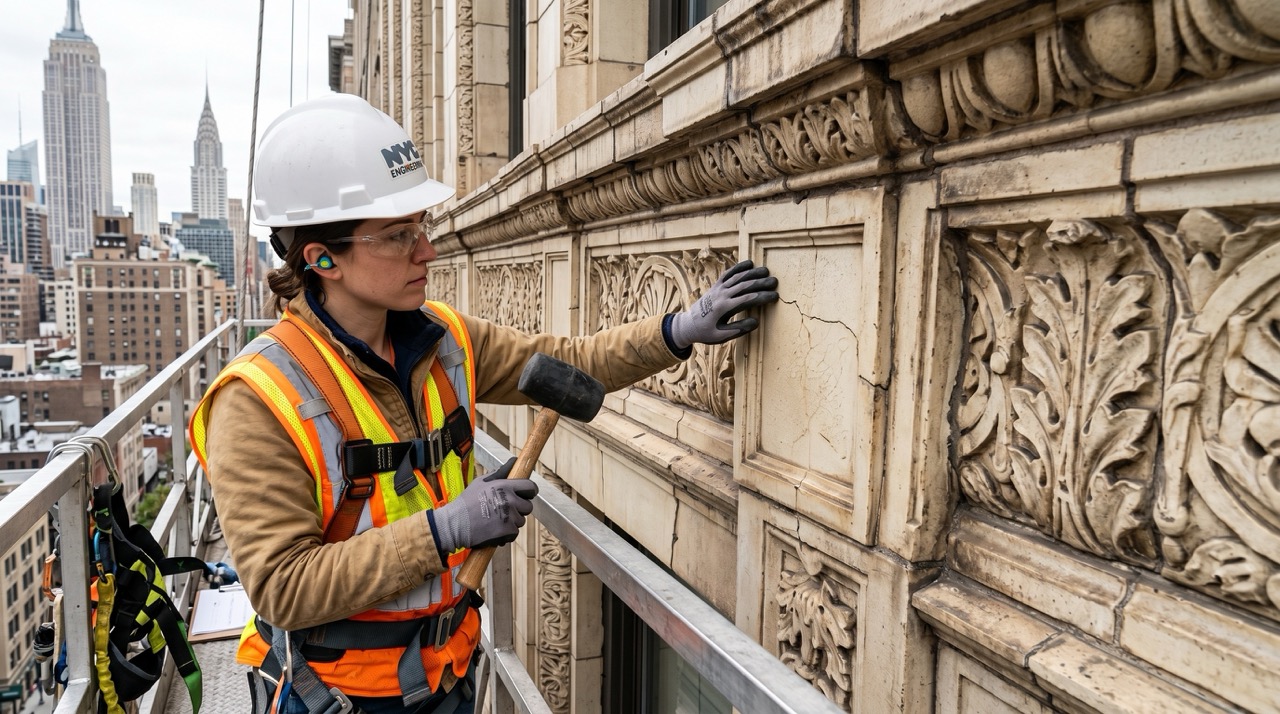
QEWI stands for Qualified Exterior Wall Inspector — the DOB designation for the licensed professional authorized to conduct FISP (Facade Inspection Safety Program) inspections under Local Law 11. A QEWI must be either a licensed professional engineer (PE) or a registered architect (RA) with specific exterior wall inspection experience.
The inspection is not a windshield survey. DOB rules require close-up physical access to every portion of the facade — every elevation, the parapet, balconies, fire escapes, cornices, window sills, lintels, and all appurtenances. This typically requires scaffolding, suspended scaffold, aerial lift, or rope access, depending on the building’s configuration.
QEWI Inspection Services We Provide
Full Cycle 10 FISP Inspections
We conduct complete FISP inspections meeting all Cycle 10 requirements, including the enhanced close-up access mandate that requires physical access to all exterior surfaces. Our inspections cover:
- All exterior wall elevations (primary street facade, rear, and all side walls)
- Parapets and copings
- Cornices, belt courses, and projecting ornamentation
- Window sills and lintels
- Balconies and their structural connections
- Fire escapes (structural condition and drainage)
- Mechanical equipment supports attached to the facade
FISP Report Preparation and DOB Filing
We prepare the technical report required by the DOB: elevation drawings with deficiency locations mapped, photographic documentation, condition narratives, and the formal classification (Safe, SWARMP, or Unsafe) for each elevation. We file the report through DOB NOW: Safety on your behalf.
SWARMP Monitoring and Repair Plans
For buildings classified SWARMP, we prepare the repair and monitoring plan required by DOB, document the monitoring schedule, and coordinate the amended filing after repairs are completed.
Unsafe Condition Response
When an inspection reveals Unsafe conditions, we mobilize immediately to establish compliant protective measures — sidewalk sheds or safety netting — and begin defining the repair scope. We prioritize speed for Unsafe situations because every day without protection is a liability exposure for the building owner.
The Inspection Process: What to Expect
Access setup — For most mid-rise buildings, a rolling tower scaffold or scissor lift provides the required close-up access. Taller buildings typically require hanging scaffold or rope access. We coordinate access equipment as part of the inspection engagement.
Field inspection — The QEWI systematically examines each elevation, probing surfaces, sounding for hollow areas, and documenting all deficiencies by location and condition type.
Deficiency documentation — Every identified deficiency is photographed and located on elevation drawings. This documentation becomes the basis for the FISP report and, if repairs are needed, the repair scope.
Report preparation and review — The technical report is prepared, reviewed internally for completeness and accuracy, and submitted to the DOB. The building owner receives a copy.
Follow-up filing — If the initial filing returns DOB objections or requests for additional information, we respond and refile as needed until the filing is accepted.
FISP Cycle 10: Key Requirements for NYC Building Owners
Cycle 10 is the current FISP cycle. Sub-cycle windows are staggered by block number; your building’s specific sub-cycle deadline is available through DOB BIS (Building Information System) or by calling 311.
What’s new in Cycle 10:
- Close-up access is required for all exterior surfaces — there are no “ground-level only” allowances for any portion of the facade
- Enhanced documentation requirements for SWARMP conditions, including photographic evidence and monitoring intervals
- DOB NOW: Safety is the required filing platform (legacy paper submissions are no longer accepted)
First-time filers — Buildings that were not required to file under prior cycles due to height thresholds or recent construction may be brought into scope under Cycle 10 if they now meet the applicable criteria.
QEWI Inspection Company NYC: Why LL11 Facade Repairs Contractor NYC
We work exclusively on NYC building envelopes. Our team understands the full spectrum of New York City’s building stock — 1910s brick walkups in Brooklyn, 1920s limestone towers on the Upper West Side, mid-century concrete buildings in Queens and the Bronx, pre-war terra cotta-clad commercial buildings in Midtown.
That specific experience matters for QEWI work, because accurate classification requires understanding not just what you see, but what it means for the specific material type. A hollow-sounding terra cotta unit on a 1920s building is a different risk profile than a similar condition on a 1970s concrete panel.
Integrated repair capability — When our inspection identifies deficiencies, we can proceed directly to repair as the same company. You avoid the coordination delay between inspection findings and contractor mobilization — a critical advantage when you’re working against DOB deadlines.
Service Areas for QEWI Inspections
We provide QEWI inspection services throughout New York City: Manhattan, Brooklyn, Queens, the Bronx, and Staten Island.
Request a Free Quote
QEWI inspection costs depend on building height, number of elevations, access requirements, and the complexity of the building’s facade configuration. Contact us for a quote based on your specific building.
Call (917) 540-6852 or use the contact form below.
Frequently Asked Questions — QEWI Inspection Services NYC
What qualifications does a QEWI need in NYC? A Qualified Exterior Wall Inspector must be a New York State licensed professional engineer (PE) or registered architect (RA) with specific exterior wall inspection experience. The DOB maintains qualification requirements under 1 RCNY 103-04, which governs the FISP program.
How much does a QEWI inspection cost in NYC? QEWI inspection costs vary significantly based on building size, height, number of elevations, and access requirements. A small 7-story building with straightforward access is substantially less expensive to inspect than a 20-story building requiring hanging scaffold on multiple elevations. Contact LL11 Facade Repairs Contractor NYC for a building-specific quote.
How long does a QEWI inspection take? The field inspection itself typically takes one to three days for most mid-rise buildings, depending on size and access setup. Preparation of the technical report and DOB filing typically takes one to two weeks after the field work is complete.
Can we schedule a QEWI inspection close to our sub-cycle deadline? We advise against waiting. QEWIs have limited scheduling capacity, particularly as sub-cycle deadlines approach. Late-cycle scheduling also leaves no time for any DOB filing objections to be resolved before the deadline. Schedule at least three to four months before your sub-cycle deadline.
What if the QEWI inspection finds UNSAFE conditions? Protective measures (sidewalk shed or netting) must be in place within 24 hours. We treat Unsafe findings as emergencies and mobilize immediately. The building owner is responsible for protective measures from the moment an Unsafe condition is identified, even before the formal FISP report is filed.