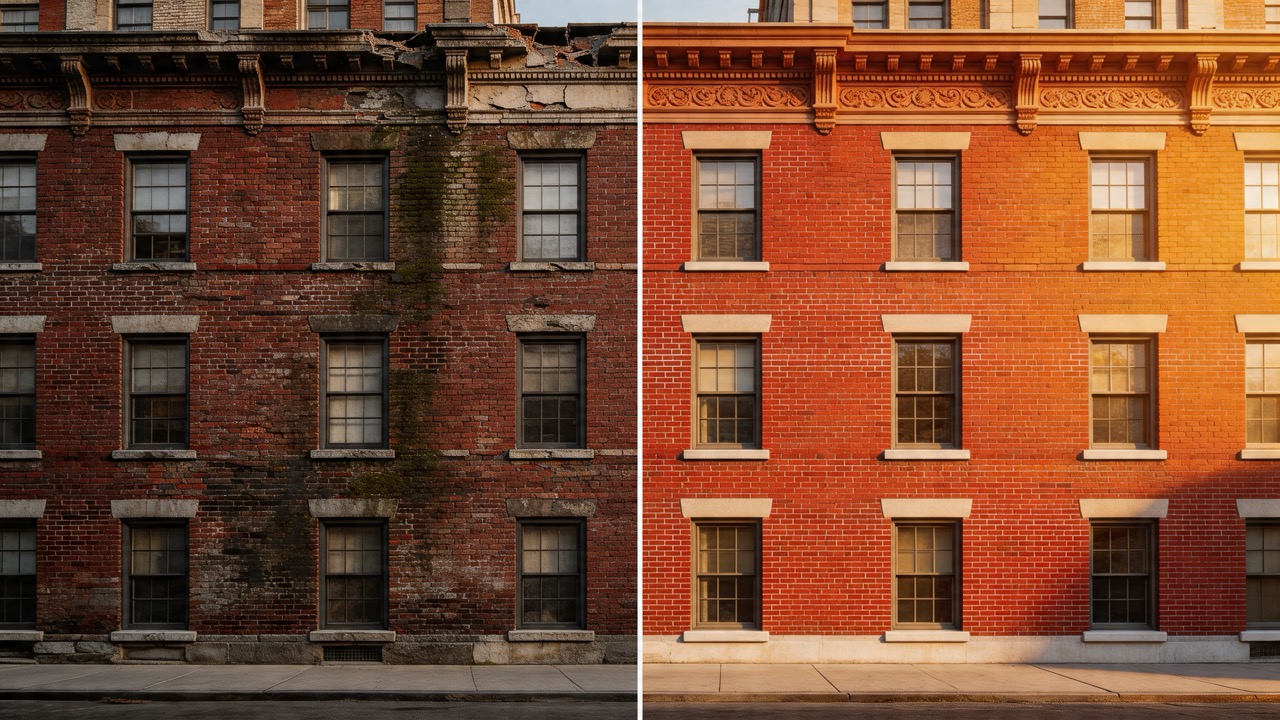
Facade Repair & Restoration
New York City’s building stock is aging. The limestone and brick facades on pre-war apartment buildings in Manhattan and Brooklyn, the early concrete towers in the Bronx, the ornate terra cotta streetscapes of Midtown — all of it deteriorates under the specific pressures of the New York climate: freeze-thaw cycles, wind-driven rain, sulfuric acid deposition, and decades of deferred maintenance. LL11 Facade Repairs Contractor NYC specializes in facade repair and restoration services that stop active deterioration, restore structural integrity, and bring buildings into FISP compliance.
Facade Repair Services: What We Do
We work on building envelopes exclusively — no general construction, no interior work. That focus means our crew has specific expertise in the materials and failure modes that define New York City’s built environment.
Masonry Repointing
Mortar joint failure is the most common facade deficiency found on NYC’s pre-war brick buildings. When mortar joints deteriorate, water infiltrates behind the facade, accelerating freeze-thaw damage and creating the conditions for brick spalling, lintel corrosion, and interior water damage.
We cut failed mortar to the required depth (minimum 3/4 inch), clean the joint thoroughly, and repoint with a mortar type matched to the existing brick’s compressive strength and the building’s exposure conditions. On pre-war buildings, this typically means a softer, lime-rich mortar — using modern Portland-heavy mixes on old brick is a common mistake that causes the brick units themselves to spall. We match mortar hardness, color, and texture to the existing joint profile.
Spalled Concrete and Brick Repair
Spalled and delaminated surfaces present a falling hazard and a FISP Unsafe trigger. We remove all delaminated material, treat exposed reinforcing steel where applicable, and restore surface profiles using polymer-modified repair mortars or epoxy systems appropriate to the specific substrate and exposure.
For concrete facades — common on 1960s and 1970s residential buildings throughout the outer boroughs — we also apply penetrating sealers after repair to slow chloride penetration and future corrosion initiation.
Terra Cotta Repair and Replacement
Pre-war Manhattan and Brooklyn are dense with terra cotta ornament — glazed and unglazed facade tiles, decorative band courses, cornices, and intricate architectural detail. When terra cotta fails, the options depend on the condition: hollow units can sometimes be secured with stainless steel tie-back anchors; cracked or structurally compromised units must be replaced.
We source period-appropriate terra cotta replacements from specialty manufacturers and match glaze profiles as closely as the current market allows. Where exact replacements are unavailable, we fabricate substitutes in glass-fiber-reinforced concrete (GFRC) shaped and colored to match.
Lintel and Shelf Angle Replacement
Steel lintels and shelf angles embedded in masonry corrode over time. As the steel expands from corrosion products, it cracks and spalls the surrounding brick — producing the characteristic diagonal crack patterns visible above window openings on many older NYC buildings. Left unaddressed, this leads to progressive brick dislodgement and eventual Unsafe conditions.
We remove the failed steel, prepare the lintel pocket, install galvanized or stainless steel replacements, reset the brick above with compatible mortar, and apply penetrating treatment to the surrounding masonry to slow future moisture ingress.
Parapet Reconstruction and Repair
Parapets are the most structurally vulnerable element of most NYC facades — they’re tall, thin, exposed on both faces, and often inadequately flashed. Parapet failures are a serious FISP concern and a significant safety risk.
We repair or reconstruct deteriorated parapets, install through-wall flashing with proper laps and terminations, and address drainage conditions at the base of the parapet that accelerate deterioration. Where a parapet has moved significantly or shows loss of structural coherence, we rebuild it to current DOB standards.
Facade Waterproofing and Sealant Systems
Water infiltration through facade surfaces and perimeter joints causes the vast majority of facade deterioration over time. We install sealant systems at window perimeters and control joints, apply penetrating water repellents to masonry surfaces where appropriate, and address through-wall and cap flashing conditions.
Waterproofing is not the same as coating — we do not apply surface-bonded coatings to historic masonry, which traps moisture and accelerates deterioration. We use breathable penetrating treatments that reduce surface absorption without trapping vapor movement.
Facade Cladding and Re-Cladding
For buildings where the existing facade is beyond economical repair, we provide facade re-cladding in metal panel systems, fiber cement, or masonry veneer systems. Re-cladding is also appropriate when a building owner wants to update the aesthetic character of a commercial building while improving thermal performance and reducing long-term maintenance.
Facade Restoration Contractors in NYC: Our Approach
Restoration work requires a different mindset than new construction. The goal is to arrest deterioration and return the building to stable, safe condition — not to make it look new.
Material matching matters. We take time to understand the original material palette — the brick color, mortar joint width and profile, the glaze on the terra cotta — and source replacements that read correctly from the street.
Moisture management drives everything. Most facade failures trace back to water. We don’t just fix the visible symptom; we identify and address the moisture source so the repair holds.
Documentation supports FISP compliance. Every repair we complete is documented with before-and-after photographs, material specifications, and the engineer sign-off needed to support QEWI re-inspection and DOB amended filing.
Service Area for Facade Repair and Restoration
We serve buildings throughout New York City: Manhattan (all neighborhoods from Battery Park to Inwood), Brooklyn (from Downtown to Bay Ridge, Williamsburg to Flatbush), Queens (Long Island City, Astoria, Jackson Heights, Flushing, Jamaica), the Bronx (Riverdale, Fordham, Mott Haven, the Grand Concourse), and Staten Island.
Request a Free Quote
Facade repair scope varies enormously by building type, height, material condition, and access requirements. Contact LL11 Facade Repairs Contractor NYC for a site assessment and project-specific quote.
Call (917) 540-6852 or use the contact form to schedule an assessment.
Frequently Asked Questions — Facade Repair and Restoration NYC
What is the difference between facade repair and facade restoration? Facade repair addresses specific deficiencies — replacing a failed lintel, repointing a section of brick, patching spalled concrete. Facade restoration is a more comprehensive program that addresses the overall condition of the building envelope, often in conjunction with FISP compliance. Both use the same trades and techniques; the difference is scope.
How do I know if my building needs facade repair? Visible signs include: staining or efflorescence (white salt deposits on the brick face), diagonal cracks above windows, spalling or loose brick or concrete, missing or cracked mortar joints, rust staining from embedded steel, and water infiltration at interior walls near the facade. Any SWARMP or Unsafe FISP designation also indicates repairs are required.
How long does facade repair take on a typical NYC building? A focused repair addressing a single deficiency type (e.g., repointing a specific elevation or replacing failed lintels on one face) typically takes 4–12 weeks from mobilization to completion, depending on scope and access method. Comprehensive restoration programs on large pre-war buildings can run 3–6 months or longer.
Do you work on landmark-designated buildings? Yes. We have experience with LPC-designated buildings and historic districts. Work on landmarked buildings requires LPC review and approval of materials and methods before work begins. We handle LPC coordination and specification preparation as part of our engagement.
Can facade repairs be phased? Yes, and it’s often the right approach. We can prioritize FISP-cited deficiencies in the first phase to achieve DOB clearance, then address remaining maintenance work in subsequent phases as budget allows.