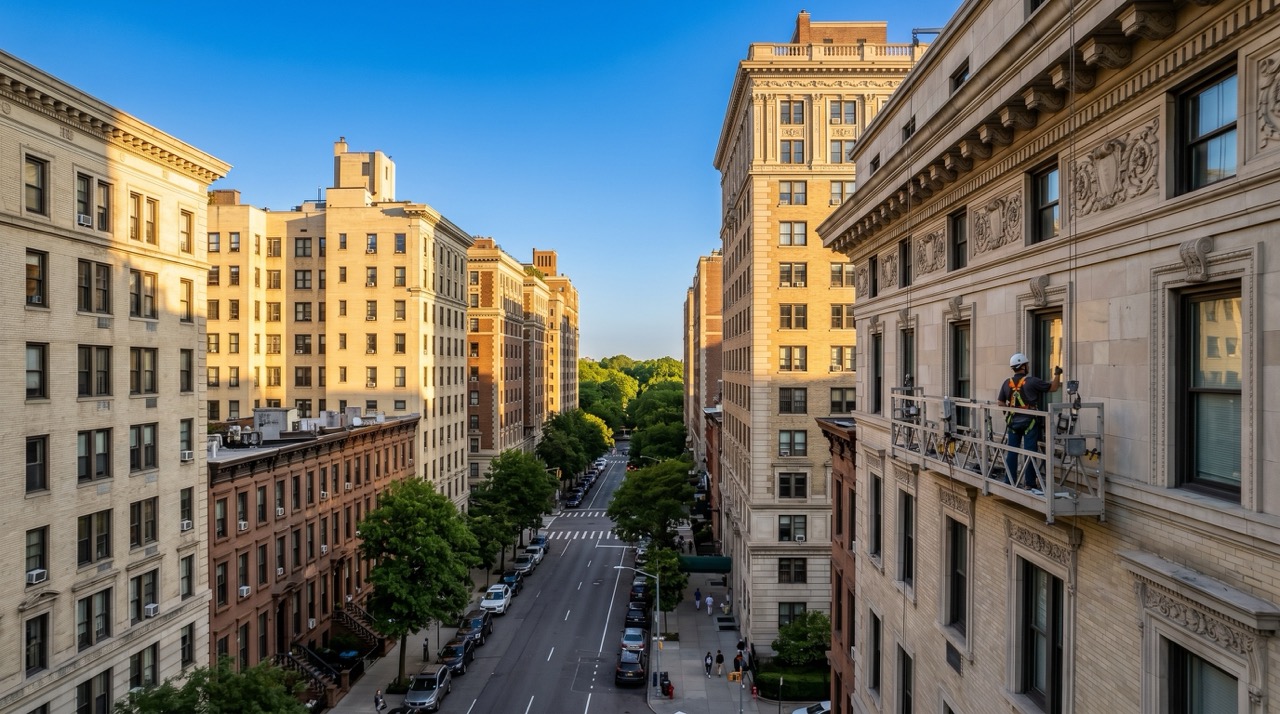
Upper West Side Facade Inspections
Upper West Side Facade Inspections
The Upper West Side is home to some of New York City’s finest residential architecture. The pre-war apartment towers lining Central Park West, Riverside Drive, West End Avenue, Broadway, and the neighborhood’s cross streets represent a remarkable concentration of high-quality masonry construction from the 1910s through the 1940s. For co-op boards, managing agents, and property owners on the Upper West Side, Local Law 11 FISP compliance is a recurring responsibility — and the combination of architectural complexity, landmark designations, and high building values raises the stakes for getting it right. LL11 Facade Repairs Contractor NYC provides LL11 facade inspection, repair, and DOB violation remediation services specifically for Upper West Side buildings.
Upper West Side Building Characteristics and Facade Conditions
Upper West Side buildings are predominantly pre-war — constructed between roughly 1900 and 1945. Their facades share common characteristics and common failure modes:
Brick construction with limestone veneer — The large apartment towers along Central Park West, Riverside Drive, and West End Avenue are typically brick construction with limestone veneer panels, limestone window surrounds, and limestone ornamental detail at cornices, parapets, and entrance surrounds. Limestone veneer requires different assessment and repair than brick masonry — limestone-to-limestone mortar joints, limestone-appropriate consolidants for deteriorated surfaces, and attention to the differential thermal movement between limestone and the brick backup.
Terra cotta ornament — Many Upper West Side buildings feature terra cotta at cornices, belt courses, and window surrounds. Close-up survey is essential to identify hollow units that are not visible from the street.
Steel windows in original frames — Many Upper West Side pre-war buildings retain original steel windows in cast iron or limestone surrounds. When window replacement is not planned, perimeter sealant maintenance is critical to prevent water from tracking into the wall assembly.
Parapet and coping conditions — The limestone-capped parapets on UWS apartment towers are a common vulnerability: coping joints open with thermal movement, allow water infiltration, and if not addressed, lead to progressive deterioration of the parapet and the wall below.
Upper West Side Historic Districts and LPC Requirements
Large portions of the Upper West Side are within Landmarks Preservation Commission-designated historic districts:
- The Upper West Side/Central Park West Historic District
- The Riverside Drive-West 80s-90s Historic District
- The Riverside-West End Historic District
Buildings within these districts require Certificate of Appropriateness review for any facade work beyond ordinary maintenance — including repointing, lintel replacement, terra cotta repair, and window work. LPC review requires application preparation, documentation of existing conditions, specification of proposed repair materials and methods, and typically 4-8 weeks for standard determinations.
We prepare LPC applications, coordinate with Commission staff, and execute work in compliance with approved specifications. Our specifications are written to receive LPC approval while also meeting the technical requirements of the repair.
LL11 Facade Inspection Services on the Upper West Side
QEWI inspections on Upper West Side buildings require careful access planning. Many buildings have setbacks and courtyards that affect scaffold configuration. The buildings are tall — often 14-20 stories — requiring hanging scaffold or building-mounted equipment for close-up access to upper floors.
We coordinate all access equipment (hanging scaffold, swing stage, or aerial lift as appropriate), manage DOT permits for sidewalk protection, and work within the scheduling requirements of building management and resident boards.
Upper West Side Facade Repair
Limestone repointing and repair — Limestone joint mortar deteriorates, limestone faces weather, and isolated limestone panels require repair or replacement. We use lime-based repair mortars and mineral consolidants appropriate to the limestone type found on UWS buildings.
Terra cotta inspection and repair — Close-up survey, stainless steel tie-back anchoring of hollow units, and unit replacement with period-appropriate materials (coordinated with LPC for designated buildings).
Lintel and shelf angle replacement — Common on UWS pre-war buildings. We replace failed steel with galvanized or stainless alternatives.
Window perimeter sealant — High-frequency maintenance need on the large window openings typical of UWS apartment buildings.
Parapet coping and flashing — We repair or replace failed coping joints, install new flashing where it has failed or is absent, and rebuild deteriorated parapet sections.
Service Area on the Upper West Side
We serve all Upper West Side blocks: from 59th Street to 110th Street (Central Park North), and from Central Park West to Riverside Drive — including all numbered streets, West End Avenue, Broadway, Amsterdam Avenue, Columbus Avenue, and the park-fronting avenues.
Request a Free Quote — Upper West Side Facade Inspections
Upper West Side facade projects typically involve LPC coordination, co-op board processes, and managing agent engagement. We work efficiently within these institutional frameworks.
Call (917) 540-6852 or use the contact form below.
Frequently Asked Questions — Upper West Side Facade Inspections
My Upper West Side co-op building is in a historic district. Does every facade repair need LPC approval? Ordinary maintenance — like-for-like replacement of failed sealant, minor patching of existing materials — typically qualifies for a staff-level LPC determination without a full Certificate of Appropriateness application. More significant work — repointing, lintel replacement, terra cotta repair, window replacement — requires a C of A application. We evaluate each scope and advise on the appropriate LPC process.
How do co-op boards typically manage LL11 facade compliance? Most Upper West Side co-op boards manage FISP compliance through their managing agent, often working with a building engineer who coordinates the QEWI inspection and provides a facade assessment report to the board. Boards then obtain contractor proposals for required work. We work effectively in this process — we can be brought in as the contractor on a board-engineer-contractor model, or we can provide integrated inspection and repair services directly.
Is LL11 Facade Repairs Contractor NYC familiar with the Upper West Side Historic District requirements? Yes. We work regularly on buildings within the Upper West Side/Central Park West Historic District and adjacent historic districts. We know what LPC approves for these buildings — the material standards, the joint profile requirements, the documentation expectations — and prepare specifications accordingly.
How do you handle noise and resident impact for facade work on occupied UWS buildings? We coordinate work hours with building management, conduct particularly noisy operations during designated hours, provide advance notice to residents when scaffold affects light or window access, and maintain clean worksite standards consistent with residential building expectations.
What does a FISP sub-cycle deadline mean for my specific Upper West Side building? FISP sub-cycle deadlines are determined by block number. The managing agent for your building should have the specific sub-cycle deadline on file. If not, we can help you locate it in DOB BIS. Upcoming Cycle 10 deadlines are staggered — we recommend confirming your deadline and scheduling inspection well in advance.